
 产业资讯
产业资讯
 复宏汉霖
复宏汉霖  2026-05-20
 1075
1075
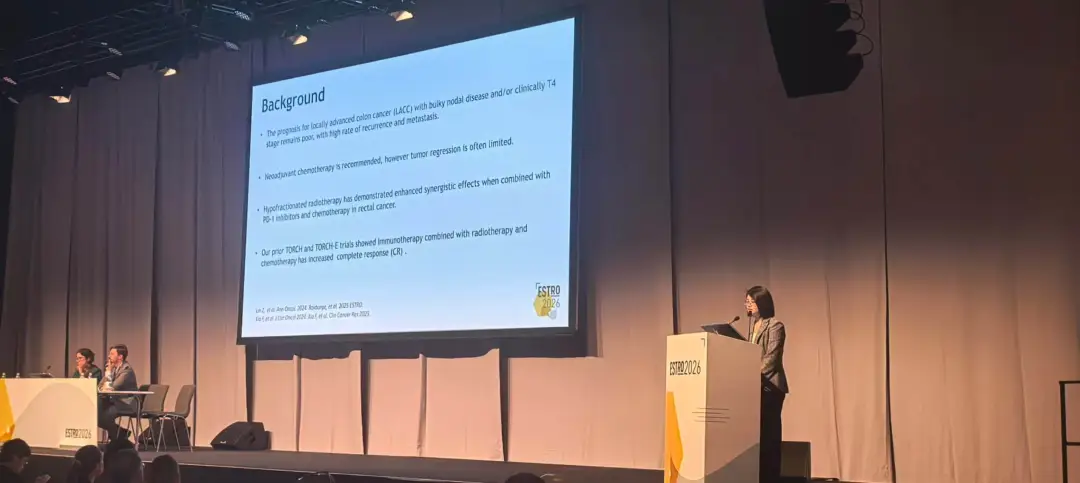
2026年欧洲放射治疗与肿瘤学会(ESTRO 2026)于当地时间5月15日至19日在瑞典斯德哥尔摩举行。在本次大会上,复宏汉霖创新型抗PD-1单抗H药 汉斯状®用于新辅助治疗高风险的局部晚期结肠癌(LACC)研究结果以口头报告形式正式发布。该研究由复旦大学附属肿瘤医院蔡三军教授和章真教授共同发起,研究结果显示,放化疗联合斯鲁利单抗显示出良好的疗效,病理完全缓解(pCR)率显著提高,达42.5%,为对照组4倍多,有望为高风险LACC提供新的治疗选择,进一步印证了H药在消化道肿瘤领域的疗效价值。
结直肠癌(CRC)是消化道肿瘤中最常见的类型之一,在我国及全球均呈高发态势。2022年全球新发约192.6万例,死亡约90.4万例;其中中国新发51.7万例,死亡24.0万例,发病率居恶性肿瘤第二位,死亡率居第四位¹⁻²。根据发病部位,结直肠癌分为结肠癌和直肠癌。约10%–15%的结肠癌患者初诊时已处于局部晚期,预后相对较差³。针对晚期结直肠癌,复宏汉霖正在全球范围内积极推动斯鲁利单抗联合贝伐珠单抗及化疗一线治疗转移性结直肠癌(mCRC)的国际多中心III期临床研究(ASTRUM-015),目前全球患者入组已完成,有望填补免疫治疗在non-MSI-H mCRC领域的临床空白。同时,在局部晚期结肠癌领域,多项由研究者发起的临床研究(IIT)正在开展,以探索H药的治疗价值。
在本次ESTRO大会上,H药联合放化疗新辅助治疗MSS/pMMR型局部晚期结肠癌(LACC)的II期研究入选口头报告。结果显示,该方案疗效显著,病理完全缓解(pCR)率达化疗对照组的4倍以上,有望为局晚期高风险结肠癌提供创新的新辅助治疗模式。该研究此前已发布于2026年ASCO GI大会,本次大会为数据更新;全部入组数据亦入选ASCO 2026,将以壁报形式发布,持续验证其稳定的临床获益。
H药是全球首个且唯一胃癌围手术期III期注册研究成功的抗PD-1单抗,也是全球首个一线治疗小细胞肺癌的抗PD-1单抗*,在肺癌和消化道肿瘤领域皆斩获全球突破性进展。凭借其差异化的机制,H药在多种实体瘤的治疗中展现出独特优势,该药物不仅具备更强的PD-1内吞作用,可减少T细胞表面PD-1受体2,实现快速、强效的免疫激活;还能减少PD-1对共刺激分子CD28的募集,从而更大程度保留CD28信号传导3-5,增强下游AKT蛋白活性6,促进T细胞持续活化。聚焦肺癌与消化道肿瘤,H药已在全球范围内**获批用于治疗鳞状非小细胞肺癌(sqNSCLC)、广泛期小细胞肺癌(ES-SCLC)、食管鳞癌(ESCC)及非鳞状非小细胞肺癌(nsqNSCLC)等多个适应症,并已在中国、英国、欧盟、新加坡、印度、瑞士、秘鲁等40多个国家和地区获批上市,覆盖全球近半数人口。
此次ESTRO 2026大会上发布的研究数据结果如下:
论文标题
新辅助放疗联合CAPOX和PD-1抑制剂治疗MSS/pMMR高风险局部晚期结肠癌:一项随机期Ⅱ试验
研究设计
总共120例LACC (T4/大体积N+M0,pMMR/MSS)患者将随机分为化疗组或放疗组。化疗组给予4个周期的CAPOX,放疗组接受短程放疗(SCRT,25Gy,5次分割),PD-1抑制剂(斯鲁利单抗)联合CAPOX治疗4个周期。放疗靶体积仅包括原发结肠肿瘤和肿大的淋巴结,没有选择性淋巴结照射。在新辅助治疗后,患者将评估根治性结肠切除术。主要终点是病理完全缓解(pCR)率。次要终点包括肿瘤降期、R0切除、3年无病生存期(DFS)、3年总生存期(OS)、3年局部无复发生存期和治疗相关毒性。
结果
截至2025年10月31日,已有120名患者入组并随机分组。其中12人退出了研究,剩下108人。完成新辅助治疗100例,手术89例(化疗组49例,放疗组40例)。89例患者均获得根治性切除,化疗组R0切除率为95.9%(47/49),放疗组R0切除率为95.3%(38/40)。化疗组pCR率(ypT0N0)为10.2%(5/49),放疗组为42.5%(17/40)。完成新辅助治疗的患者中最常见的3-4级不良事件(AE)是血小板减少症,化疗组为18.4%(9/49),放疗组为22.5%(9/40)。
结论
PD-1抑制剂、SCRT和化疗联合应用效果良好,可显著提高MSS/pMMR高危LACC患者的pCR率。该方案可能为实现R0切除和提高长期生存率提供新的治疗选择。
*截至2026年5月19日
**不同国家或地区的获批适应症请以当地药品监管部门发布的公告为准
关于复宏汉霖
复宏汉霖(2696.HK)是一家国际化创新生物制药企业,致力于为全球患者提供高品质、可负担的生物药,产品覆盖肿瘤、自身免疫疾病、眼科疾病等领域。自2010年成立以来,公司已构建涵盖全球研发、临床、注册、生产及商业化的全产业链平台,拥有全球员工近4,000人,并在中国、美国和日本等多地设有运营及分支机构。依托生物类似药形成的稳健现金流反哺创新研发,复宏汉霖正稳步迈入“全球化2.0”阶段,持续打造可复制、可持续的全球增长模式。截至2026年初,公司共有10款产品在全球60余个国家和地区获批上市,其中7款已在中国获批。在欧美主流生物药市场,复宏汉霖亦取得多项里程碑式突破,已有4款产品获得美国FDA批准、5款产品获得欧盟EC批准,充分体现了公司在研发体系、质量管理及生产能力方面已全面对标国际最高标准。
在创新驱动方面,复宏汉霖依托上海、美国等多地协同布局的研发体系,构建了多元化、平台化的创新技术矩阵,覆盖免疫检查点抑制剂、免疫细胞衔接器(包括多特异性TCE)、抗体偶联药物(ADC)以及AI驱动的早期研发平台等前沿方向。目前,公司拥有50余项处于早期阶段的创新资产,其中约70%具备同类最佳(Best-in-Class)潜力,并在全球同步推进30余项临床研究。核心产品H药 汉斯状®(斯鲁利单抗,欧洲商品名:Hetronifly®)作为全球首个获批一线治疗小细胞肺癌的抗PD-1单抗,正加速全球布局,已在全球40余个市场获批上市;同时,多款潜力创新资产,包括PD-L1 ADC HLX43及新表位HER2单抗HLX22正全面推进全球关键性临床研究。依托通过中、欧、美三地GMP认证的生产体系,复宏汉霖已建成总产能达84,000升的生物药生产平台,形成覆盖全球六大洲的稳定供应网络。未来,复宏汉霖将始终坚持以患者为中心,聚焦未满足的临床需求,持续推动创新成果向临床价值与患者可及转化,在全球生物医药创新生态中创造长期而稳健的价值。
ESTRO 2026 | Henlius' Serplulimab Achieves 42.5% pCR Rate in Neoadjuvant Colon Cancer; Study Results Presented Orally
The 2026 European Society for Radiotherapy and Oncology (ESTRO 2026) was held in Stockholm, Sweden, from May 15 to 19 local time. At this conference, Henlius' innovative anti-PD-1 monoclonal antibody(mAb) serplulimab was officially presented in an oral report for its neoadjuvant therapy study results in locally advanced high-risk colon cancer (LACC). The study was jointly initiated by Professor Sanjun Cai and Professor Zhen Zhang of Fudan University Shanghai Cancer Center. The results showed that radiochemotherapy combined with serplulimab demonstrated favorable efficacy, with the pathological complete response (pCR) rate significantly increased to 42.5%, representing more than a four-fold improvement over the control group. This offers a new treatment option for high-risk LACC and further validates the therapeutic value of serplulimab in the field of gastrointestinal cancers.
Colorectal cancer (CRC) is among the most common gastrointestinal malignancies and remains a major health burden in China and worldwide. In 2022, there were approximately 1.926 million new cases worldwide and about 904,000 deaths; among them, China accounted for 517,000 new cases and 240,000 deaths, ranking second in incidence and fourth in mortality among malignancies.¹⁻² Based on the site of occurrence, colorectal cancer is divided into colon cancer and rectal cancer. Approximately 10%-15% of colon cancer patients are already in a locally advanced stage at initial diagnosis, with relatively poor prognosis.³ For advanced colorectal cancer, Henlius is actively promoting a global multicenter Phase 3 clinical study (ASTRUM-015) of serplulimab combined with bevacizumab and chemotherapy as first-line treatment for metastatic colorectal cancer (mCRC). Patient enrollment has been completed globally, aiming to fill the clinical gap in immunotherapy for non-MSI-H mCRC. Meanwhile, in locally advanced colon cancer, multiple investigator-initiated trials (IITs) are underway to further assess the therapeutic value of serplulimab.
At this ESTRO conference, the Phase 2 study of serplulimab combined with chemoradiation as neoadjuvant therapy for MSS/pMMR-type LACC was selected for oral presentation. The results showed significant efficacy, with the pCR rate reaching more than four times that of the chemotherapy control group, offering an innovative neoadjuvant treatment model for locally advanced high-risk colon cancer. This study was previously presented at the 2026 ASCO GI conference, and this conference provided updated data; all enrollment data were also selected for ASCO 2026 and will be presented in poster form, continuously validating its stable clinical benefits.
Serplulimab is the world’s first and only anti-PD-1 mAb to achieve success in a Phase 3 registrational study for perioperative gastric cance and the first anti-PD-1 mAb approved for the first-line treatment of SCLC*, marking global breakthroughs in both lung and gastrointestinal cancers. Serplulimab demonstrates unique advantages in treating various solid tumors via its differentiated mechanism. The drug not only induces stronger PD-1 internalization—reducing PD-1 receptor presence on T cells for rapid and potent immune activation4—but also minimizes PD-1-mediated recruitment of the co-stimulatory molecule CD28, thereby preserving CD28 signaling,5-7 enhancing downstream AKT activity,8 and promoting sustained T-cell activation. Focused on gastrointestinal cancers and lung cancer, serplulimab has been approved for the treatment of squamous non-small cell lung cancer (sqNSCLC), extensive-stage small cell lung cancer (ES-SCLC), ESCC, and non-squamous non-small cell lung cancer (nsqNSCLC)**. Up to date, it has been approved in over 40 countries and regions including China, the United Kingdom, the European Union, Singapore, India, Switzerland, and Peru, covering nearly half of the global population.
The results of the study released at 2026 ESTRO are as follows:
Title: Neoadjuvant radiotherapy combined with CAPOX and PD-1 inhibitor for MSS/pMMR high-risk locally advanced colon cancer: a randomized phase Ⅱ Trial
Study design: A total of 120 LACC (T4/bulky N+M0,pMMR/MSS) patients will be randomized to either a chemotherapy group or a radiotherapy group. The chemotherapy group receives 4 cycles of CAPOX. The radiotherapy group receives SCRT(25Gy in 5 fraction)and 4 cycles of the PD-1 inhibitor (serplulimab) combined with CAPOX. The radiotherapy target volume includes only the primary colon tumor and enlarged lymph nodes, without elective nodal irradiation. After neoadjuvant therapy, patients will be evaluated for radical colon resection. The primary endpoint is pathological complete response (pCR) rate. The secondary endpoints include tumor downstaging, R0 resection, 3-year disease free survival (DFS), 3-year overall survival (OS), 3-year local recurrence-free survival and treatment-related toxicity.
Results: As of October 31, 2025, 120 patients have been enrolled and randomized. Of these, 12 withdrew from the study, leaving 108 remaining. 100 patients have completed neoadjuvant treatment and 89 have received surgery (49 in the chemotherapy group, 40 in the radiotherapy group). All 89 patients achieved radical resection, with R0 resection rates of 95.9% (47/49) in the chemotherapy group, and 95.3% (38/40) in the radiotherapy group. The pCR rate (ypT0N0) was 10.2% (5/49) in chemotherapy group and 42.5% (17/40) in the radiotherapy group. The most common grade 3-4 adverse event (AE) among patients completing neoadjuvant treatment was thrombocytopenia, that 18.4% (9/49) in the chemotherapy group and 22.5% (9/40) in the radiotherapy group.
Conclusion: The combination of PD-1 inhibitor, SCRT, and chemotherapy shows promising efficacy and may significantly improve pCR rates in patients with MSS/pMMR high risk LACC. This regimen may provide a new therapeutic option to achieve R0 resection and improve long-term survival.
* As of May 19, 2026
** Approved indications may vary by country or region. Please refer to announcements issued by local regulatory authorities for approved indications in each market.
About Henlius
Shanghai Henlius Biotech, Inc. (2696.HK) is a global, innovation-driven biopharmaceutical company committed to delivering high-quality, affordable biologic therapies to patients worldwide. The Company focuses on major disease areas including oncology, autoimmune diseases, and ophthalmic diseases. Founded in 2010, Henlius has established an integrated, end-to-end biopharmaceutical platform encompassing global R&D, clinical operations, regulatory affairs, manufacturing, and commercialisation. The Company employs nearly 4,000 people globally and operates across multiple regions, including China, the United States, and Japan. Leveraging the stable cash flow generated from its biosimilar portfolio to support innovation, Henlius is steadily advancing into its “Globalisation 2.0” phase, building a scalable and sustainable global growth model. As of early 2026, Henlius has achieved regulatory approvals for 10 products across over 60 countries and regions worldwide, including seven approvals in China. The Company has also reached multiple milestones in major biopharmaceutical markets, with four products approved by the U.S. Food and Drug Administration (FDA) and five products approved by the European Commission (EC), reflecting its globally aligned R&D capabilities, quality systems, and manufacturing standards.
Driven by innovation, Henlius has built a diversified, platform-based technology ecosystem through coordinated R&D efforts across Shanghai, the United States, and other regions. Its innovation platforms span immune checkpoint inhibitors, immune cell engager technologies (including multispecific T cell engagers), antibody-drug conjugates (ADCs), and AI-enabled early discovery platforms. The Company currently has more than 50 early-stage innovative assets, approximately 70% of which are expected to be best-in-class, with over 30 clinical trials ongoing globally. Henlius’ core product, serplulimab (trade name: Hetronifly® in Europe), is the world’s first anti–PD-1 mAb approved for first-line treatment of small cell lung cancer and has been approved in more than 40 markets worldwide with an accelerated globalisation process. In parallel, multiple high-potential innovative assets—including the PD-L1 ADC HLX43 and the novel epitope anti-HER2 mAb HLX22—are advancing through global pivotal clinical development. Supported by a biologics manufacturing network with a total capacity of 84,000L and GMP certifications from regulatory authorities in China, Europe, and the United States, Henlius has established a stable global supply system serving six continents. Guided by a patient-centred mission, Henlius remains focused on addressing unmet medical needs and translating scientific innovation into meaningful clinical value and patient access, contributing sustainably to the global biopharmaceutical ecosystem.
To learn more about Henlius, visit https://www.henlius.com/en/index.html and connect with us on LinkedIn at https://www.linkedin.com/company/henlius/.
 产业资讯
医药地理 2026-07-24
356
产业资讯
医药地理 2026-07-24
356
 产业资讯
BiG生物创新社 2026-07-24
490
产业资讯
BiG生物创新社 2026-07-24
490
 产业资讯
瞪羚社 2026-07-24
327
产业资讯
瞪羚社 2026-07-24
327
 热门资讯
热门资讯 微信公众号
微信公众号